Some dream of inventing the next blockbuster video game, while others already imagine studios bursting with creativity. But behind the bright facade of video game schools, the reality quickly reveals itself: here, project management and logistics coexist with even the smallest animation, while team protocols often take precedence over solitary inspiration. The gap is striking. One learns this by moving from an enticing brochure to the actual classroom: juggling digital rights, taming deadlines, understanding the technical back office—this is the menu. Programming, sometimes relegated to the background, is left to the initiative of the student or pushed back to the working world. Whether graduated or not, no one opens the door wide for you: the industry evolves quickly, and the balance between personal ambitions, market expectations, and educational projects is negotiated daily.
Overview of training pathways in video games: schools, curricula, and specificities
Choosing a pathway is not obvious. In France, video game schools are multiplying, whether they are located on the outskirts of Paris or rooted in Lyon, Bordeaux, or elsewhere. Curricula continue to diversify, embracing the expansion of the sector: animation bachelor’s degrees, master’s programs designed for game designers, and technical training dedicated to development. This offering welcomes profiles that blend artistic flair with mastery of digital tools.
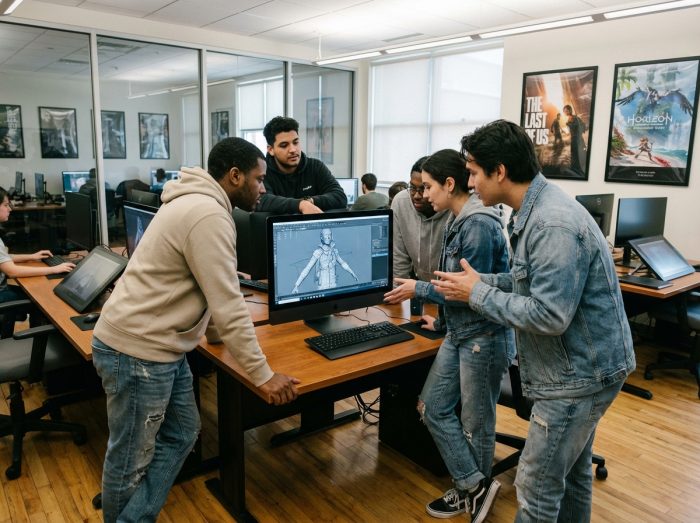
Joining a school means passing a selection process that probes motivation and the ability to cooperate. In the field, from the very first weeks, students are confronted with very concrete projects: virtual reality, prototype creation, fast-paced project management—all under the watchful eye of industry professionals. The tempo is set, stress management quickly becomes essential, and everyone grapples with reference software like Unity or Unreal Engine. It is impossible to move forward without learning to communicate effectively and work with other profiles.
Collective work becomes central. Workshops, projects in teams: these are opportunities to face unexpected challenges and stubborn bugs. Experience builds the ability to bounce back after failure, to turn criticism into progress. Over the sessions, everyone realizes that the key skills of video game schools are not limited to pure technique. One must know how to adapt, innovate, and navigate an industry that is always on the move.
This range of training opens the door to various professions: developers, digital animators, esports specialists, designers. Schools adjust their content and methods, refine their links with studios, while maintaining a constant watch on industry practices.
What professions are actually available after a video game school?
For graduates, the range of professions continues to expand. Some choose the path of video game developer, where the ability to code in Unity or Unreal is sought after. Others turn towards game design, which involves imagining the structure, internal logic, and narrative of the game. The sector has never been so abundant.
Here are some concrete areas that a training program might target:
- Programming and technical integration, to shape and optimize the game’s framework.
- Art direction and graphic design, when aesthetics guide creation.
- Interactive narrative design, dedicated to storytelling and writing player journeys.
- Video editing and post-production, to rhythm, assemble, and finalize visual and animated sequences.
- Project management and coordination, essential supports for any ambitious team.
The list is never static. The sector now welcomes many video editors, profiles coming from event management or digital production, sometimes revealed through specialist fairs like Paris Games Week and the vitality of esports. Opportunities extend to agencies, independence, and even pure freelancing.
Video game professions revolve around adaptability and constant learning: from quality control to creating animated content, from event management to coordinating internal teams. Those who stand out navigate skillfully between multiple functions and open up to new professional horizons as they emerge.
Evolving in a changing industry: how schools prepare for tomorrow’s challenges
It is impossible to close one’s eyes to the technological pace of the sector. Rather than passing on ready-made recipes, schools focus on experimentation and project-based learning. Each student immerses themselves in a group dynamic, learning to build, arbitrate, and deliver on time.
The classrooms are filled with 3D animation stations, tools for virtual reality, and collaborative devices. The instructors bring their studio experience to immerse students in reality: nothing beats a bug to fix in an emergency or a schedule disrupted at the last minute to confront the realities of the field. The demand to defend an idea before peers and learn to nuance one’s certainties in the face of collective constraints is also crucial.
Tools, methods, and languages evolve year by year, pushing for renewed reflexes and stepping out of comfort zones. In this perpetual movement, the ability to collaborate and anticipate becomes just as decisive as technical know-how. The school aims to shape professionals capable not only of adapting but also of influencing and even anticipating the next trends.
The video game industry continues to transform; each new school year reshuffles the cards, triggers skill mutations, and brings forth jobs that did not exist the day before. What matters is the ability to remain curious, to adjust, and to cultivate the audacity to explore the digital realms yet to be invented.