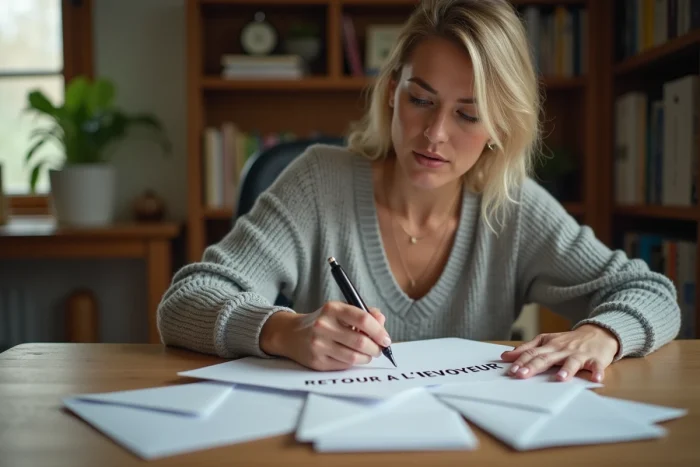
You receive an envelope in the mailbox, the name doesn’t match, the address is approximate or completely wrong. The reflex to place it on the counter while waiting does not solve anything. The mail remains stuck, the real recipient never receives it, and you end up with a letter that doesn’t belong to you, not knowing what to do with it concretely.
Secrecy of correspondence and GDPR: what you risk by keeping foreign mail
Before even talking about returning it, a legal point often ignored must be made. Opening or keeping mail that is not addressed to you can constitute a violation of the secrecy of correspondence under the Penal Code. Article 226-15 provides penalties for anyone who opens, destroys, or diverts a letter addressed to a third party.
Since the implementation of the GDPR, a second risk arises when the mail contains personal information (contact details, customer number, health data). Keeping this data without a legal basis constitutes unlawful processing under personal data protection regulations. The CNIL has reiterated this combination of issues in its guides updated in 2022-2023.
In practice, no one will come to your door for a letter forgotten on the living room table. The criminal risk mainly concerns deliberate opening. However, keeping an envelope containing sensitive data places you in a gray area that you can easily avoid by returning it.
When you need to return mail to the wrong address, the process varies depending on whether the error comes from the sender, the postal service, or a former occupant who did not forward their mail.
NPAI mention on the envelope: the method that works with La Poste
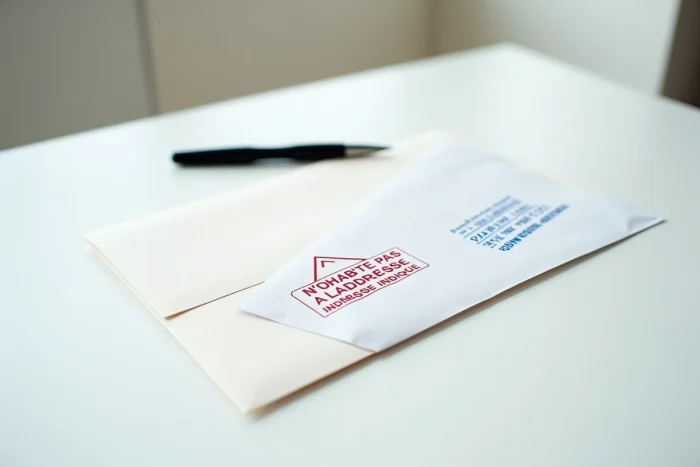
NPAI means “Does Not Live at the Address Indicated”. It is the mention that the postman uses when he identifies an addressing problem. You can do the same.
Concrete steps to follow
- Cross out the recipient’s address with a clear line without making it unreadable (the return service needs to read it to identify the sender in its database)
- Write “NPAI – return to sender” legibly on the front of the envelope, preferably with a dark ballpoint pen
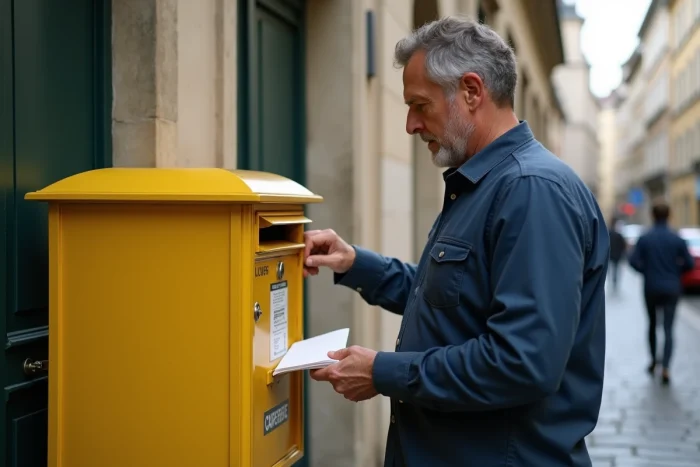
- Drop the letter into a yellow mailbox of La Poste, without additional postage: the return is covered under the initial postal contract
This procedure works for ordinary mail. For registered mail or parcels, the process differs since the postman usually expects a signature. If a registered letter arrives with an unknown name, refuse it directly at the time of delivery. The refusal automatically triggers a return to the sender.
What happens next from the sender’s side
When the envelope returns with the NPAI mention, the sender receives a clear signal: the address in their file is outdated or incorrect. Companies that send mass mail (banks, insurance companies, administrations) have systems that automatically update their databases after an NPAI return. A single return from you can therefore be enough to stop the flow.
Online reporting and postal complaint: the digital channels to use
Returning the mail to the yellow box resolves the majority of cases. When the problem persists (recurring mail from a former tenant, systematic delivery errors), we move to reporting.
La Poste has generalized since 2023-2024 an online complaint process accessible from a customer account. You declare a distribution problem, describe the situation, and a follow-up is opened. The advantage compared to going to the counter: a written record and a case number.
What can be reported via the online form
- Mail delivered to the wrong address repeatedly (postman’s error or confusion of mailboxes in a building)
- Mail from a former occupant that continues to arrive despite several NPAI returns
- Parcel or registered mail delivered to you by mistake when the address does not match
The form does not replace the physical act of returning the letter. The two are complementary. The return deals with the current mail, the complaint corrects the source of the problem.
Mail from a former tenant: stopping the flow when the NPAI mention is no longer enough
This is the most common and annoying scenario. You move in, and for months, you receive bank statements, bills, administrative letters in the name of the person who lived there before.
The NPAI mention works well when the sender properly manages their returns. Large companies generally update their database after one or two returns. Returns vary in this regard: some smaller organizations, associations, or local public services do not always handle NPAIs with the same rigor.
If after several weeks the mail continues to arrive, there are two options:
The first is to identify the main sender and then contact the relevant organization directly. A call to customer service or a message via the online space is often enough. Explain that you now occupy the housing and that the mentioned person no longer lives at this address. Request the removal of the address from their file.
The second option involves the online postal complaint already mentioned. By reporting that the problem concerns a former occupant, you allow the local post office to add a note to your address.
Address error on mail you sent: correcting the mistake
The other side of the problem: you are the sender and realize, after dropping it in the box, that the recipient’s address is wrong or incomplete. The margin for maneuver depends on the type of sending.
For a tracked or registered mail, contact La Poste’s customer service as quickly as possible. A request for interception or redirection can be attempted as long as the letter has not been presented to the recipient. This procedure is not guaranteed, but the quicker the request, the higher the chances of success.
For ordinary mail without tracking, the situation is easier to accept: no interception mechanism exists. The letter will either be delivered despite the error (if the postman identifies the correct recipient), or it will be returned to the sender’s address if it is on the back of the envelope. Hence the importance of always mentioning your address on the back, a reflex that facilitates the return in case of delivery issues.
Misdirected mail rarely ends up in a black hole. Between NPAI returns, online reporting, and direct contact with recurring senders, each situation has its solution. The most effective gesture remains the simplest: a line across the address, three words on the envelope, and a trip to the yellow box.