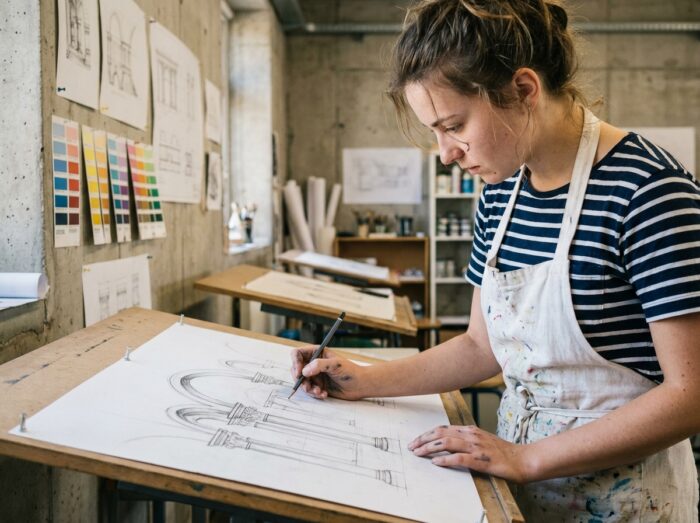
The MANAA has not existed since 2019, but the market for private artistic preparatory courses has never been so dense. General or vocational baccalaureate holders aiming for a DN MADE or a prestigious design school are faced with a plethora of preparatory year options, often sold under the ghost label “ex-MANAA.” The question of the return on investment for this transitional year deserves a technical examination, not a commercial discourse.
Artistic prep and Parcoursup selection: what juries really evaluate
The admission commissions for DN MADE or higher art schools do not grade a CV. They evaluate a portfolio, a motivation letter, and the coherence of the project. The portfolio is the main filter, far ahead of the transcript.
A STD2A graduate arrives with three years of practice in applied arts, a refined plastic vocabulary, and methodological references. A general baccalaureate holder, even if brilliant, does not have this foundation. The preparatory year is precisely designed to bridge this gap, not to “discover one’s creativity” as some brochures claim.
We observe that candidates from a solid preparatory course present more structured portfolios, with a diversity of mediums (volume, typography, rough, color) that self-taught individuals struggle to achieve alone. Considering a leveling up in applied arts before entering prestigious schools makes perfect sense when the Parcoursup file relies so heavily on plastic production.
The portfolio remains the decisive selection criterion, and this is where the preparatory year brings measurable value. Without it, the motivation letter sounds hollow.
DN MADE and prestigious design schools: two circuits, two application logics
The DN MADE, a national diploma awarded over three years conferring a bachelor’s degree, is applied for exclusively through Parcoursup. The prestigious schools (ENSAD, ENSCI, schools of fine arts, Penninghen, Strate) manage their own entrance exams with drawing tests, artistic culture, and interviews before a jury.
The preparatory course prepares for two types of exams simultaneously. This is a point that serious training programs incorporate into their curriculum, while low-end offers settle for free workshops without pedagogical framing.
The expected skills differ according to the circuit:
- For DN MADE: ability to formulate a project approach, mastery of fundamentals (observational drawing, color, composition), culture of design and crafts.
- For entrance exams to higher schools: ease in quick drawing under time constraints, solid general artistic culture, ability to defend a viewpoint before a jury.
- For both: a coherent portfolio showing progression and plastic curiosity, not an accumulation of “pretty drawings.”
A preparatory course that only trains for one of these two formats limits opportunities. We recommend checking, before enrollment, if the program includes mock exams and portfolio reviews by external professionals.
Private applied arts prep: criteria to distinguish a useful training from a marketing product
The term “artistic prep” does not correspond to any regulatory framework. Any structure can open a preparatory year in applied arts without authorization. This lack of regulation explains the considerable quality gap between offers.
Supervision by teachers currently employed in higher education is the first reliable indicator. An instructor who sits on an admission commission knows what the juries expect. A freelance graphic designer, no matter how talented, does not have this insight.
Three operational criteria allow for sorting:
- The placement rate of former students in public DN MADE or higher schools, verifiable by directly contacting previous cohorts.
- The hourly volume dedicated to observational drawing and projects (not to general culture lectures, which can be studied independently).
- The organization of mock juries with professionals outside the school, at least twice a year.
The cost of these programs varies greatly. The price does not correlate with pedagogical quality. Some public preparatory courses linked to high schools offer rigorous programs without tuition fees, while private structures charge several thousand euros for superficial support.
STD2A Bac and artistic prep: who really needs this additional year
Holders of the STD2A bac already have the fundamentals in applied arts. For them, the preparatory year often represents a pedagogical redundancy. Their application for DN MADE or higher school relies on a technical foundation built over three years of high school.
The prep is primarily aimed at general and vocational baccalaureate holders who have not followed a structured artistic curriculum. It is for these profiles that the gain is most significant: acquisition of technical drawing, introduction to creation software, methodical construction of the portfolio.
A general baccalaureate holder with sustained personal practice (regular sketchbook, documented personal projects, internships in agencies or studios) can try their luck directly. The risk is presenting a file lacking methodological rigor, even if artistic sensitivity is present.
The decision rests on an honest self-assessment: does the candidate master observational drawing, layout, and the basics of color? If two of these three skills are lacking, the transitional year is not a waste of time; it is a technical investment. If the profile is already solid, it is better to dedicate this year to strengthening the portfolio independently and apply directly.