
Planning meals for the week means deciding in advance which dishes to prepare each day and deriving a shopping list from that. The main benefit is not about the cooking itself, but about eliminating the daily micro-decisions that tire you out even before you open a cupboard.
The real barrier to planning: a lack of ideas, not a lack of time
Most meal planning dropouts happen in the first few weeks. The reason is rarely a time issue: it’s a repertoire problem. When faced with a blank slate and unsure of what to write down, planning becomes an additional chore instead of a relief.
The classic reflex is to search for new recipes on a search engine. The result: half an hour of browsing for just one selected dish, often too ambitious for a Tuesday night. A personal repertoire of tried-and-tested dishes changes the game. With about twenty mastered recipes, filling out a plan takes just a few minutes.
For those who want to vary your menus with myn idee on Le Bio du Coin, the idea is to regularly feed this repertoire with suggestions tailored to seasonal products, without starting from scratch each week.
Building a recipe repertoire by basic category
Classifying dishes by main ingredient (vegetables, starches, proteins) rather than by cuisine type simplifies rotation. A rice-based dish can be a risotto, a stir-fried rice with vegetables, or a cold mixed salad. Three different meals, one starch in stock.

Classifying by base also allows for more efficient shopping. If the week includes two dishes based on root vegetables and two dishes based on rice, the ingredient list remains short and leftovers can be easily reused.
Here’s a simple structure to organize this repertoire:
- Starch base: pasta, rice, potatoes, semolina. Listing three to four mastered dishes per starch is enough to cover several weeks without repetition
- Vegetable base: group by season. Winter vegetables (squash, leeks, cabbage) and summer vegetables (zucchini, tomatoes, eggplants) require different cooking methods
- Protein base: distinguish between animal proteins (poultry, fish, eggs) and plant proteins (lentils, chickpeas, tofu) to alternate without thinking about it at every meal
This grid is not rigid. The goal is to be able to draw from each column and compose a balanced menu in just a few minutes.
Menu rotation and seasonality of products
A planning system that works over time relies on a cycle, not on weekly creation. The simplest approach: build four weeks of menus and rotate them. You get a complete month of planned meals, modifiable on the margins according to cravings or current promotions.
The seasonality of vegetables and fruits naturally imposes a renewal of this cycle. A January menu featuring butternut squash and leeks will be replaced in June by dishes based on zucchini and tomatoes. This rhythm avoids monotony without requiring a constant effort of creativity.
Adding one or two new dishes per month to the repertoire is enough to gradually refresh the cycle. Testing a recipe on the weekend, when cooking time is more ample, then integrating it during the week if it fits, creates a steady flow of ideas without pressure.
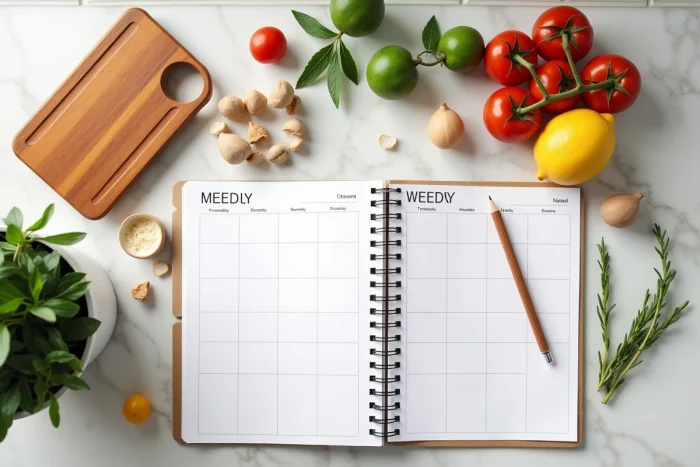
Shopping list: from the menu to the ingredients, not the other way around
The common mistake is to do grocery shopping first, then look for what to cook with what you bought. This approach generates food waste: fresh products bought without a destination often end up at the back of the refrigerator.
Starting from the menu to build the shopping list reverses the logic. Each planned dish generates a line of ingredients. You then group by section (fruits and vegetables, grocery, fresh, frozen) to speed up your time in the store.
Some concrete principles for an effective list:
- Check existing stock before writing the list. Condiments, spices, and dry starches last a long time and are often found in duplicate in cupboards
- Group purchases by frequency: fresh products (vegetables, meat, fish) are bought once or twice a week, dry and frozen products once or twice a month
- Plan a “joker” meal each week, based on long-lasting ingredients (pasta, canned legumes, eggs), for the nights when the plan falls through
This joker meal absorbs unforeseen events without derailing the entire week. An overly rigid weekly menu leads to abandonment at the first deviation.
Adapting planning to the real constraints of the week
A realistic meal plan takes into account the time available each evening. Placing a long dish (casserole, stew) on Sunday or a telecommuting day, and reserving busy evenings for recipes that take less than twenty minutes, changes the perception of effort.
The technique of partial batch cooking fits well with this logic. Preparing a base usable for several meals on Sunday (a broth, a tomato sauce, roasted vegetables in large quantities) reduces cooking time during the week without requiring three hours behind the stove on the weekend.
Planning quantities for two meals when preparing a dish that reheats well (soups, curry, bean chili) frees up an additional evening. Leftovers become a second planned meal, not a last-minute fix.
Weekly menu planning becomes more effective when it relies on a personal repertoire, a seasonal cycle, and a shopping list built from the chosen dishes. The joker meal and partial batch cooking absorb the week’s uncertainties without turning organization into a rigid constraint.