Don’t rely on luck to grow an alstroemeria from a cutting: even the slightest neglected detail, from not having clean tools to poorly calibrated humidity, can jeopardize the whole endeavor. Some varieties seem stubbornly resistant to rooting as soon as their ideal conditions are not met. Conversely, some hybrids, more accommodating, take quickly under plastic, provided their thick roots are neither disturbed nor thirsty. Rooting hormone gets a lot of attention, but the truth is that without a solid foundation, it cannot compensate for any shortcomings.
Understanding alstroemeria for better propagation
Alstroemeria, often nicknamed Inca lily, quickly develops a robust temperament as soon as it finds itself in well-draining, light soil. Heavy or waterlogged ground, and the plant wilts without appeal. Hidden from view, its rhizomes benefit from meticulous soil preparation to offer, starting in June, a profusion of flowers that sometimes stretch until the first frosts.
While many turn to safe bets like Alstroemeria aurea or the ‘Indian Summer’ variety, everyone faces the same imperatives: never stagnant water, impeccable potting soil quality. At the cutting stage, every step must be planned in advance; otherwise, the bed will remain sadly sparse. Those who wish to succeed in alstroemeria cuttings quickly realize that success hinges on mastering every detail.
Among the fundamental strengths to know to promote success, several advantages of this perennial deserve attention:
- Prolonged and abundant flowering: stems renew continuously, from summer to the first chills.
- Rich and filtering soil: any compact or deficient soil blocks its development.
- Appropriate propagation technique: division, seeding, or cutting, each method corresponds to a specific situation and the age of the mother plant.
It’s better to proceed step by step and avoid haste: this is where the true success of alstroemeria in the garden lies.
Selecting the right path: seeding, division, or cutting
Propagation of alstroemeria can take three distinct paths. First, seeding: this is for the more patient, as seeds are harvested at the end of summer and then undergo a cold period before germinating later in spring. The result? Often, the young plants differ significantly from the original specimen.
Another option: dividing an already well-established clump. This operation involves carefully separating the rhizomes with their associated buds. The slightest clumsiness slows down the restart or even halts it altogether. This method ensures a clone of the original plant.
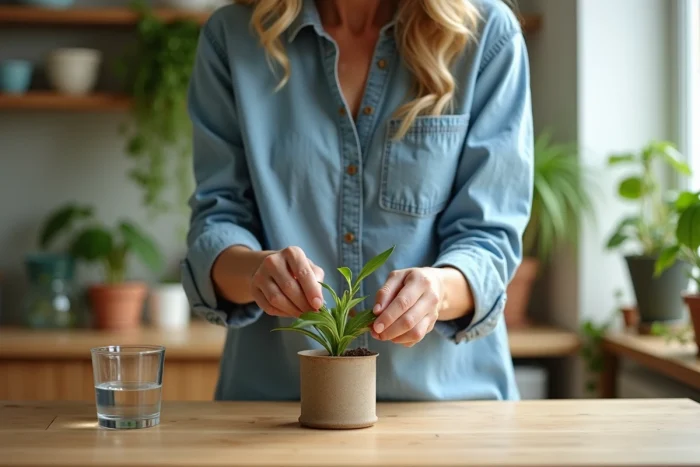
Finally, cuttings: this requires special attention. A semi-woody stem, at least 12 cm long, is cut, and the lower leaves are removed. Sometimes with rooting hormone, always in a light substrate, under a tunnel or mini-greenhouse to maintain humidity: consistency remains key. If everything is respected, root emergence follows after a few weeks.
To summarize, it’s useful to keep in mind the strengths of each approach:
- Seeding: takes time, offers surprises, and is for those who want to test new hybrids.
- Division: true to the original plant, best suited for mature plants.
- Cutting: offers great guarantees, but allows for no approximations.
Ensuring recovery and supporting growth
It’s all the follow-up after propagation that makes the difference. Excess water rots the fleshy roots, and forgetting to water finishes off a young shoot in full recovery. Alstroemeria leaves little margin for error.
As soon as the first new leaves appear, the young plant can be transplanted into soft potting soil; any transition to open ground will wait until the risk of frost has passed. During the season, a gentle fertilizer application and protection from the cold ensure a lasting establishment.
Some practices to maintain until maturity offer the best guarantees:
- Provide a balanced fertilizer in spring to stimulate vegetative restart.
- Watch for the arrival of harmful visitors like aphids or spider mites, especially if the young plant remains sheltered.
- Install mulch in autumn to strengthen the base and filter the rigors of winter.
As winter approaches, watering should be restricted. A saturated soil condemns the rhizome and, with it, any hope of renewal the following season.
Those who arm themselves with consistency and attention are rewarded with a rare prize: over the years, their bed expands, and alstroemeria becomes the centerpiece of the most beautiful summer moments in the garden.