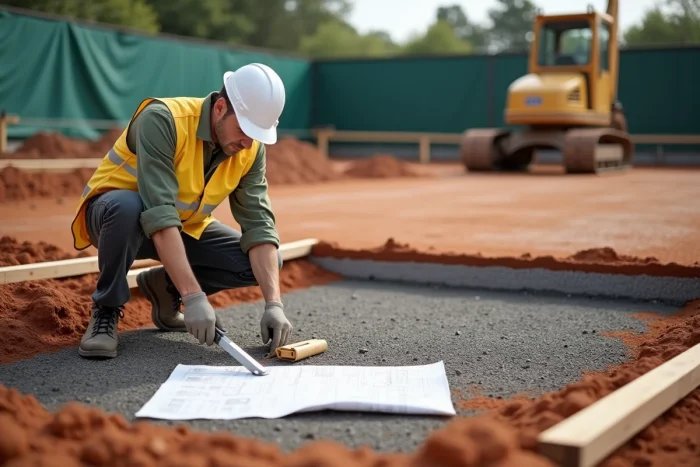
The construction of a tennis court requires skills that go far beyond simply pouring a slab. Between soil constraints, local regulatory obligations, and the choice of surface, every technical decision affects the court’s durability for decades. The role of the professional builder begins well before the first shovel is used, starting with the geotechnical study, and continues until the completion of the work.
Stormwater Management: The Constraint That Projects Underestimate
In recent years, local regulations in France have increasingly required that outdoor court projects incorporate stormwater management and runoff systems. A tennis court represents a significant impermeable surface, and urban planning services now demand compensatory solutions before granting permits.
An experienced builder anticipates this point from the study phase. Depending on the nature of the soil and the topography, options range from classic peripheral drains to buried retention systems, as well as permeable surfaces. The choice of system directly impacts the earthworks budget and the timeline for obtaining the permit.
Field feedback varies on the long-term effectiveness of draining surfaces in high rainfall regions. Some builders prefer a calibrated slope towards a retention basin rather than integrated soil permeability, which can clog over time. This is a technical decision that only a professional familiar with local conditions can make correctly.
Researching tennis court construction with a builder allows one to gauge the extent of administrative and technical procedures even before selecting a surface.
Tennis Court Surface: Clay, Resin, or Synthetic Grass
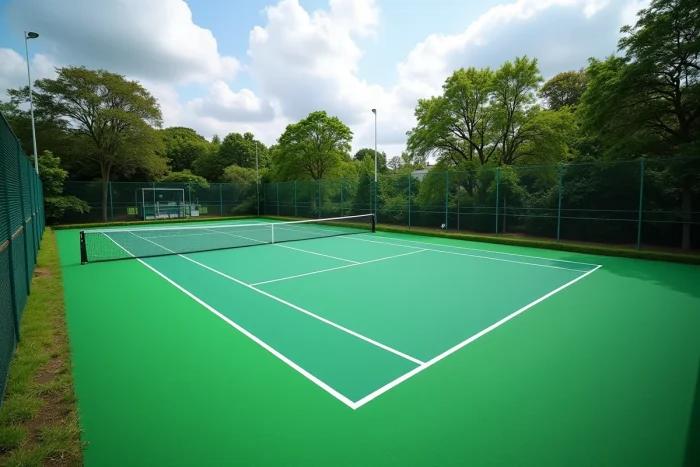
The choice of surface determines both the comfort of play, the level of maintenance, and the longevity of the court. Three main categories dominate the French market.
- Clay remains the historical surface, valued for its joint comfort and slow play. Its maintenance is demanding: regular watering, brushing, seasonal restoration. It is suitable for clubs with dedicated staff.
- Acrylic or polyurethane resin surfaces offer a hard or semi-cushioned surface, with reduced maintenance. Their lifespan depends on the quality of installation and UV exposure. They are the dominant choice for private courts and communities seeking a balance between performance and maintenance.
- Synthetic grass is gaining ground, especially for mixed tennis-padel projects. It absorbs shocks well and tolerates intensive use, but its quality varies significantly from one manufacturer to another. The infill (sand, rubber) influences the bounce and behavior of the ball.
A professional builder does not merely lay the surface. They adapt the slab structure, the thickness of the foundation layers, and the drainage system to the chosen surface type. A resin laid on a poorly prepared base will crack within a few seasons.
Sustainable Criteria and Accessibility for People with Reduced Mobility
The International Tennis Federation (ITF) has been urging builders since 2023 to integrate environmental sustainability and accessibility for people with reduced mobility criteria into new projects. This includes reducing heat islands by choosing light colors, soil permeability, and using materials with a lower carbon footprint. These recommendations, although not yet mandatory in France, are nonetheless guiding public tenders.
Renovation or New Construction: A Financial Decision to Make Early
The European and North American markets have shown a documented increase in projects to transform existing courts in recent years, at the expense of new constructions. Converting a hard court to a cushioned resin surface, or transforming a tennis court into a padel court, significantly reduces earthworks costs and authorization timelines.
For a club or community, renovating an existing court costs significantly less than new construction, provided the base structure is sound. The builder conducts a slab diagnosis, checks the drainage condition, and assesses compatibility with the new surface being considered.
On the other hand, a court with structural cracks or settling in its foundation often requires complete reconstruction, negating the economic advantage of renovation. Available data do not allow for a universal threshold of obsolescence beyond which new construction becomes systematically preferable: each case depends on the soil, climate, and maintenance history.
Choosing a Tennis Court Builder: Technical Criteria
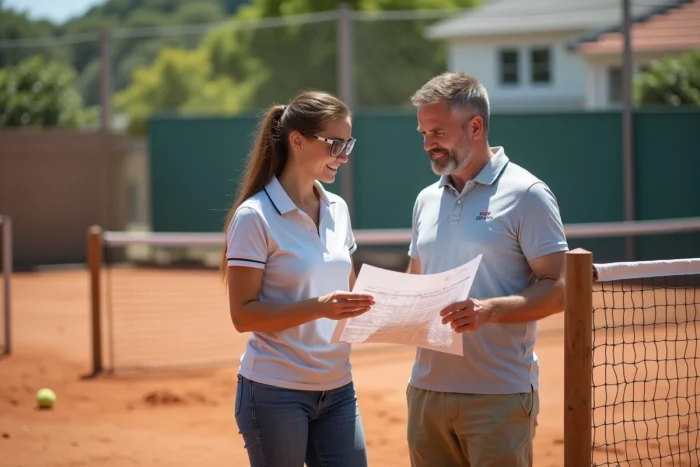
Not all builders master all surfaces or local regulatory specifics. A few verification points can help filter serious providers.
- The ability to provide a geotechnical study of the soil before any quote, not after the contract is signed.
- Verifiable references on similar projects in terms of surface area, surface type, and climatic context.
- Complete handling of administrative procedures, including stormwater management and any accessibility obligations.
- A ten-year guarantee covering the structure of the court, not just the surface layer.
The professional builder coordinates the earthworks, drainage, surface installation, and equipment setup (net, fencing, lighting). A single point of contact reduces the risks of poor workmanship associated with the multiplication of uncoordinated subcontractors.
The tennis court remains a civil engineering work in its own right. The quality of the foundation, invisible once the surface is laid, determines the court’s durability over the next fifteen to twenty years. Choosing a builder based solely on the price per square meter ignores what happens beneath the surface, where the project’s durability is truly at stake.