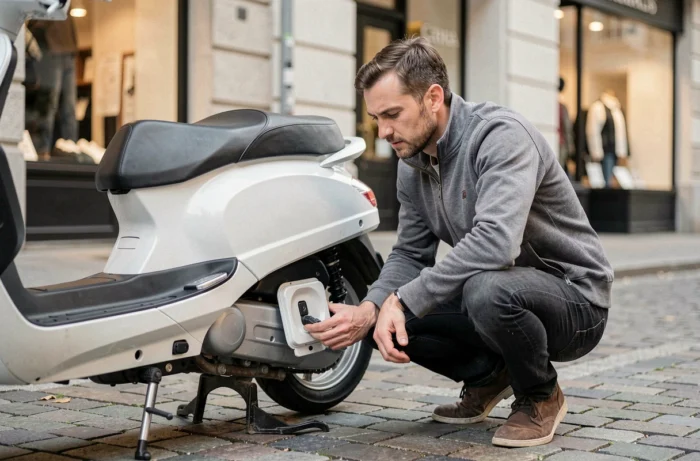
A scooter storage compartment that refuses to open isn’t always caused by the same problem. The key may be lost, the lock seized by corrosion, or the internal cable broken. Each situation calls for a different response, and using the wrong method often makes the problem worse. Before forcing anything, identifying the cause of the jam can save time and avoid unnecessary costs.
Diagnosing a jammed scooter storage compartment: three problems, three solutions
| Symptom | Likely cause | Recommended action | Risk of using the wrong method |
|---|---|---|---|
| The key is missing or broken in the lock cylinder | Lost key or fragment stuck inside | Extract the fragment or have a new key made | Damaged lock cylinder, requiring complete replacement |
| The key turns normally, but the compartment stays closed | Opening cable is loose, jammed, or broken | Access the cable through an alternative opening (if provided by the manufacturer) | Working on the lock will not solve the problem |
| The key goes in but is difficult or impossible to turn | Seized lock (corrosion, dust, moisture) | Lubricate the lock cylinder with a suitable penetrating lubricant | Forcing the key could break it inside the cylinder |
This table summarizes the three most common scenarios. If the key turns but doesn’t open the compartment, the problem is with the cable, not the lock. Persisting with the lock in this case means addressing the wrong component.
For each situation, there are specific steps you can try before contacting a professional. Many scooter owners look for ways to open their scooter storage compartment without a key, even when the problem isn’t with the key itself.
Seized scooter lock: lubrication and the limits of penetrating lubricant
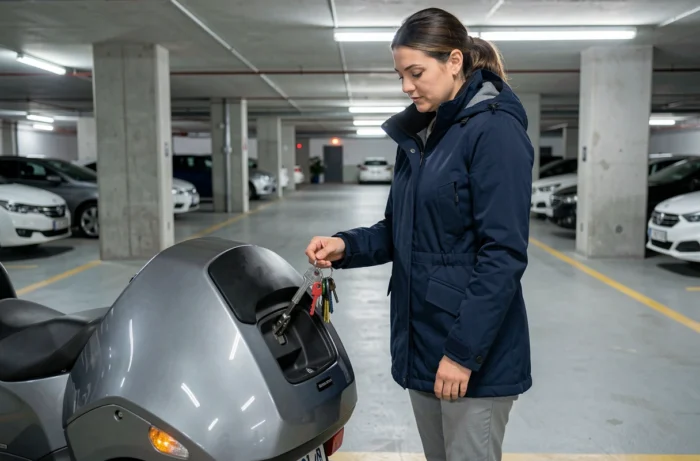
A storage compartment lock exposed to the elements will eventually corrode. Moisture, road dust, and winter road salt attack the internal pins in the lock cylinder. The typical symptom: the key goes in but meets unusual resistance when turned.
Spraying penetrating lubricant directly into the lock cylinder will free up most seized locks. Let it work for a few minutes, then insert the key and turn it gently, using small back-and-forth movements.
What to avoid with a seized lock
- Using cooking oil or thick grease: these products attract dust and make the lock more likely to seize over time
- Forcing the key to turn with pliers or another tool: a key broken inside the lock cylinder turns a minor seizure into a complete replacement
- Heating the lock with a lighter: the heat can warp the plastic bodywork around the lock cylinder
If two applications of penetrating lubricant, ten minutes apart, make no difference, the internal corrosion is too advanced. The lock cylinder must be replaced.
Faulty storage compartment release cable: why the lock isn’t to blame
On most scooters, the storage compartment lock operates a metal cable connected to a latch. When the cable becomes loose, gets stuck in its sheath, or breaks, the key turns normally but the compartment won’t open. This is often mistaken for a problem with the lock.
Some manufacturers provide an alternative way to access the release cable, usually under the seat or behind a side panel. Its location varies by model and year. The owner’s manual will tell you whether one is available and where to find it.
Emergency access to the cable: there’s no universal method
Not all scooters have an emergency release. A technique shown in a video for a specific model may not work on another—and could even cause damage. Before trying anything, checking the scooter’s exact model details in the manufacturer’s documentation is the only reliable approach.
If the cable is accessible, pulling it directly by hand will release the compartment. If the cable is broken, it must be replaced, which usually requires removing some bodywork panels.
Lost or electronic scooter key: when a professional is the only option
Losing your scooter key can’t be fixed with penetrating lubricant or by pulling on a cable. The lock cylinder is intact, but there’s nothing left to operate it.
For a scooter with a standard mechanical key, an automotive locksmith can make a duplicate using the lock cylinder’s serial number. On models equipped with an electronic key or immobilizer, things are more complicated: making a new key requires specialized programming that only a dealer or vehicle key specialist can perform.
Documents to prepare before the service call
A reputable professional will ask for the scooter’s registration document and proof of identity before carrying out the work. These checks help prevent fraudulent service calls. Having these documents ready before you call will speed up the process.
Insurance coverage and assistance: two separate benefits
An assistance policy may cover roadside repairs or towing for your scooter without covering the cost of making and programming a new key. Contacting your insurer before incurring any costs will help you understand what your policy covers and excludes. Some plans reimburse the cost of a key; others don’t.
It’s understandable to want to force open a jammed scooter storage compartment when your helmet or documents are trapped inside. First identifying whether the problem is with the lock, the cable, or a missing key can prevent a simple fault from turning into an expensive repair. After two unsuccessful attempts using the steps suited to the identified cause, calling a professional is still the most cost-effective solution.