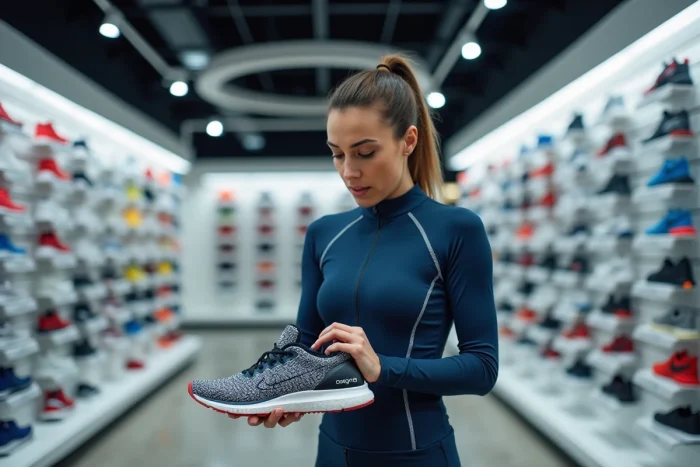
A pair of shoes that causes blisters after twenty minutes, shorts that chafe with every stride, a racket too heavy for the wrist: inappropriate equipment not only spoils the enjoyment but also hinders progress and exposes one to injuries. Choosing sports gear is not just about comparing prices or following trends. The real criterion is the coherence between the equipment, your body, and your actual practice.
Sports Shoes: The Choice That Changes Everything for Injury Prevention
The shoe is often implicated in knee or shin pain, and not necessarily because it costs too little. A literature review published in 2023 in the British Journal of Sports Medicine shows that the match between the shoe and the training load matters more than the price range.
The weekly volume, the type of surface (road, trail, indoor), and the foot morphology are the three parameters to prioritize.
The classic trap is to buy a popular shoe online without a real fitting. A model designed for urban pavement does not protect on a rocky trail, even if it costs twice as much. Conversely, a casual runner does not need a carbon-plated competition shoe, which is often less stable and more demanding on the joints.
Start by identifying your practice volume, then test several models in-store at the end of the day (the foot swells slightly over the hours). A half-size margin at the toe prevents most black nails and recurring blisters. Browsing the equipment on Carnet de Sportive also allows you to compare ranges by discipline to refine your selection.
Adapting Sports Equipment to Your Morphology and Hormonal Profile
Since 2023, the French Society of Exercise and Sports Medicine has emphasized a long-ignored parameter: equipment must take into account age and hormonal profile, particularly in women. This is not a marketing detail. The risk of stress fractures increases during perimenopause and post-menopause, making the choice of cushioning and support in shoes even more critical.
The sports bra illustrates this principle well. A model that is too compressive or too soft alters running posture and generates muscle compensations in the trapezius and back. Specialists recommend adapting the type of support to the menstrual cycle, as ligament laxity varies according to hormonal phases.
Concrete Criteria for Equipment Suitable for Your Body
- Test the shoe with the sock you wear during training, not with a thin city model. The thickness changes how the foot fits in the shoe.
- Choose a sports bra whose straps do not slip when you raise your arms above your head. The jump test (ten jumps in place) remains the best check in the fitting room.
- If you play racquet sports, check the grip circumference: a handle that is too thin or too thick for your hand increases tension on the forearm and promotes tendinitis.
- For athletes over fifty, reinforced cushioning at the heel and a sole with a soft flex zone reduce joint strain, even during brisk walking.
Quality and Durability of Equipment: How to Avoid Waste Without Sacrificing Performance
ADEME and the European Outdoor Group published converging reports in 2023 on a behavioral change: regular practitioners increasingly prioritize the reparability of their equipment. Available spare parts, the possibility of resoling, abrasion-resistant fabrics: these criteria now weigh in the purchasing decision.
This is not just a passing ecological trend. Durable equipment may sometimes cost more upfront, but it avoids the need to repurchase every six months. A good indicator: check if the brand offers a repair service or replacement components (laces, insoles, helmet foams).
Guidelines for Assessing Durability Before Purchase
Look at the fabric density. A fabric that is too thin wears out after a few washes and loses its moisture-wicking properties. Heat-sealed seams withstand repeated friction better than traditional seams, but they are more difficult to repair.
Quality sports equipment is recognized by the availability of its spare parts, not by its logo. If the manufacturer does not sell a replacement insole for your trail shoe, question the actual longevity of the product.
Choosing Sports Equipment by Discipline: Common Mistakes
Versatile equipment is an appealing promise, but rarely delivered. The French Society of Exercise and Sports Medicine confirms: the multisport shoe does not provide the same support as a shoe designed for a specific movement. A pivot in a fitness class, a jump landing in basketball, and a running stride put different demands on the foot.
- In running, the sole must absorb repeated vertical shocks. The drop (the difference in height between heel and forefoot) influences stride mechanics: a low drop suits runners accustomed to landing midfoot, while a higher drop better accommodates heel strikes.
- In indoor sports (handball, volleyball, badminton), the sole must grip the floor without leaving marks. Lateral support is a priority to protect the ankle during quick direction changes.
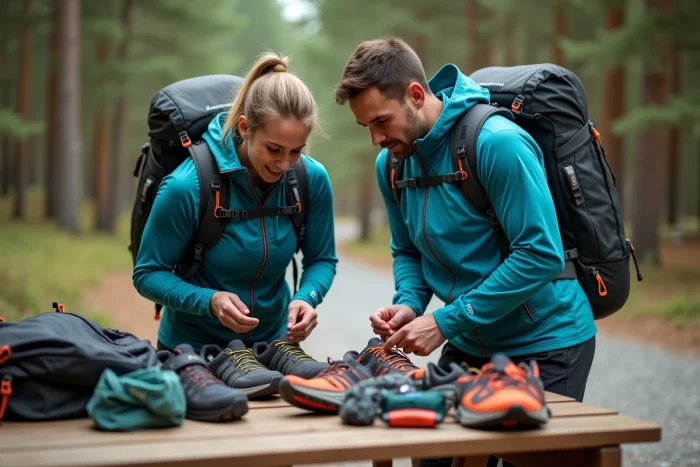
- In hiking, the stiffness of the sole and the height of the upper depend on the terrain: flat trails, mid-mountain, or high mountain require different levels of protection.
Before finalizing a purchase, ask yourself a simple question: what specific movement will this equipment serve? If the answer remains vague (“a bit of everything”), the risk of an unsuitable choice significantly increases. It is better to have good equipment for the main discipline than generic equipment for three activities.
The choice of sports equipment is based on three concrete pillars: the correspondence with your actual practice, the adaptation to your morphology, and the product’s ability to last over time. Equipment that meets these three conditions provides better protection, lasts longer, and allows the body to focus on progress rather than compensating for poorly chosen tools.