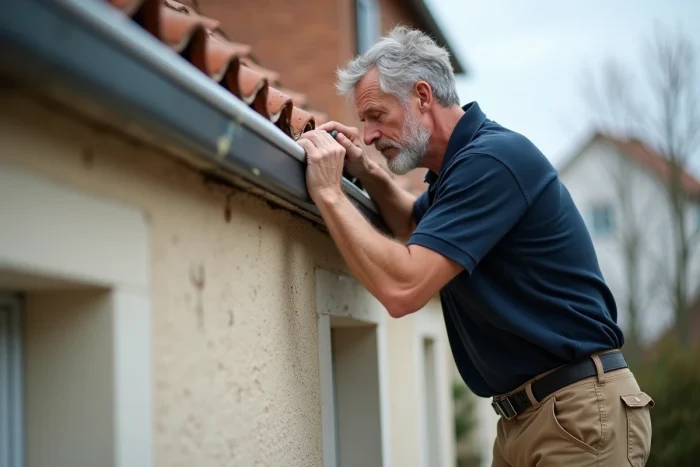
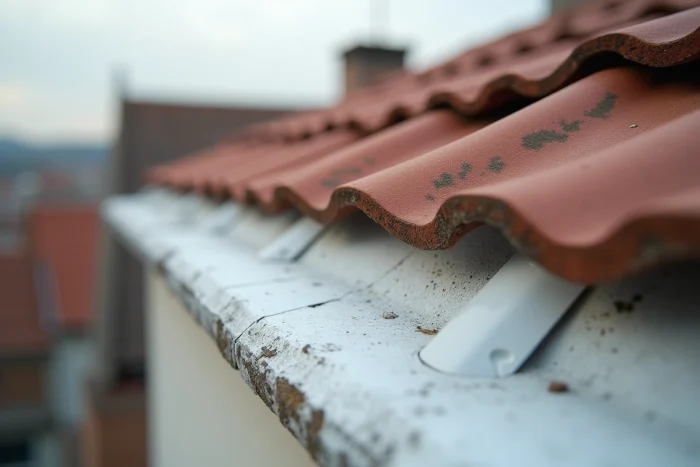
The PVC sparrow cache is a soffit board fixed between the facade wall and the roof overhang. Its primary function is to close the space under the rafters to prevent the intrusion of birds, rodents, and moisture into the framework. The PVC material, made from polyvinyl chloride, withstands the elements without requiring periodic treatment, unlike wood, which needs staining or painting every few years.
Since January 2026, the decree of November 12, 2025, amending the DTU 40.11, requires the integration of pest-proof sparrow caches in the declarations of new roofs in urban areas. This regulatory obligation enhances the importance of mastering the installation of this finishing element, even on atypical framework configurations.
PVC sparrow cache on steep roofs and metal frameworks
Most guides describe installation on wooden rafters with a standard roof slope. On a roof with an inclination exceeding 45 degrees and a metal framework, the method changes radically. PVC cannot be directly screwed into steel without adaptation: self-drilling screws for metal replace wood screws, and support profiles must be fixed with pop rivets or hex head screws suitable for the thickness of the steel profile.
The steep slope also alters the geometry of the board. The angle between the facade wall and the soffit becomes sharper, reducing the usable width of the PVC cladding. It is then necessary to cut the boards at an angle with a jigsaw, allowing for a few millimeters of expansion gap at each end to absorb thermal variations.
On a metal framework, condensation is a frequent trap. Steel conducts cold and promotes the formation of droplets under the soffit. Planning for ventilation openings (perforated slats or grids integrated into the PVC profiles) helps maintain an airflow that expels moisture and protects the insulation. Without this circulation, condensation accelerates the degradation of the fixings and the board itself.
To successfully install a PVC sparrow cache in this configuration, using a stable scaffold (rather than a simple ladder) is highly recommended: the steep slope makes working at height riskier and the working angle less comfortable than at a low incline.
Fixing PVC profiles: the role of the support and expansion gap
The U-profile (or starter profile) is the piece that receives the edge of the cladding boards. It is fixed to the facade wall on one side and to the eaves board on the other. On a masonry support, hammer-in anchors are sufficient. On wood, stainless steel screws of 30 to 40 mm do the job. On metal, the self-drilling screws mentioned earlier are the only reliable option.
The expansion gap is the technical point most often overlooked. PVC expands due to heat. Without free space at the ends of each board, the board can warp in summer and may unclip. Allowing a few millimeters of space between the board and the back of the profile absorbs these movements.
The boards fit together using a tongue and groove system. The first board inserts into the wall profile, the next clicks into the previous one, and so on until the edge profile. The last cladding board is cut to width to fit, then slides into the finishing profile.
Choice of fixings according to the support
- Concrete or brick wall: nylon hammer-in anchors with screws of 5 mm diameter, length adapted to the thickness of the coating plus the depth of anchorage in the block.
- Wood eaves board: flat head stainless steel screws to avoid corrosion, screwed every 30 to 40 cm along the profile.
- Metal framework or support: stainless steel self-drilling screws, with a sealing washer if the area is exposed to water rising from lateral wind.
Durability of PVC sparrow cache: UV, material quality, and maintenance
Not all PVC is created equal. A field study conducted by CAPEB in February 2026 noted cracking of low-end PVC caches after only 18 months of exposure to intense UV in southern France. UV-stabilized models last significantly longer, as the stabilizer integrated into the material slows down the molecular degradation caused by sunlight.
For homes located in coastal areas, PVC has an advantage over aluminum. According to the technical guide from UNPCA published in April 2026, PVC is more resistant to saline corrosion than aluminum in marine environments, which extends the lifespan of the board without additional surface treatment.
Regular maintenance of PVC sparrow cache
Cleaning is limited to a low-pressure water jet once or twice a year, supplemented if necessary by a cloth soaked in soapy water to remove pollution or moss stains. Abrasive products and solvents should be avoided: they attack the finish layer and accelerate yellowing.
Checking the condition of the fixings each year, especially after episodes of strong winds, allows for the detection of a dislodged profile or unclipped board before water infiltrates the framework. A well-installed and regularly checked sparrow cache retains its properties for many years without heavy intervention.

Ventilation of the soffit and compliance with DTU 40.11
Ventilation is not an aesthetic detail. DTU 40.11, reinforced by the November 2025 decree, requires air circulation under the covering to avoid moisture-related pathologies (condensation, rotting of adjacent wood elements, mold). Perforated PVC sparrow cache boards fulfill this function: their calibrated perforations allow air to pass while blocking insects and small animals.
On a new roof in an urban area, the absence of a pest-proof sparrow cache may lead to non-compliance with the DTU and pose a problem in the event of a claim covered by the ten-year insurance. This regulatory constraint applies to both new constructions and major roof renovations.
The sizing of ventilation openings depends on the roof area and the type of covering. In practice, alternating a solid board and a perforated board along the entire length of the overhang ensures an effective compromise between airflow and protection against intrusions.
In steep configurations with metal frameworks, this point deserves particular attention. Natural draft is more pronounced, and excessive low ventilation can create a cold air draw in winter if the entries are not properly sized.