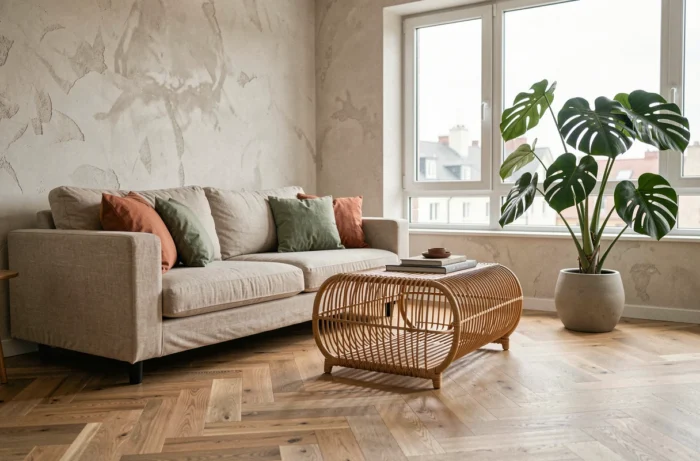
Wall finishes and textile coverings are no longer chosen solely from a color chart. Indoor air quality, material traceability, and furniture durability redefine decorative choices long before style comes into play. Transforming an interior with trendy decor now requires balancing technical criteria with deliberate aesthetic choices.
Emission labeling and wall covering choices
Every paint, coating, or wallpaper sold in France carries an indoor air emission label, rated from A+ to C. We recommend only selecting references rated A+ for any living space or bedroom. This criterion immediately eliminates part of the mass-market catalog, but it directs you towards ranges whose composition limits volatile organic compounds to the strict minimum.
This constraint is not new; however, it remains almost absent from decor inspiration articles. In practical terms, an A+ rated lime plaster or a mineral paint provides a sought-after deep matte finish this season while ensuring healthy indoor air. Panoramic wallpapers, which are very present in current projects, deserve the same vigilance: including the adhesive, the complete wall system must maintain the A+ level.
To refine your choices of materials and colors room by room, the guide on Arno Déco details the combinations that work without sacrificing air quality.
Furniture reparability: what the ESPR regulation changes for interior decor
The European regulation on the ecodesign of durable products (ESPR) includes furniture within its scope. The direction is clear: material traceability, recyclability, and reparability become product criteria, not just marketing arguments. For a trendy decor project, this changes the evaluation criteria at the time of purchase.
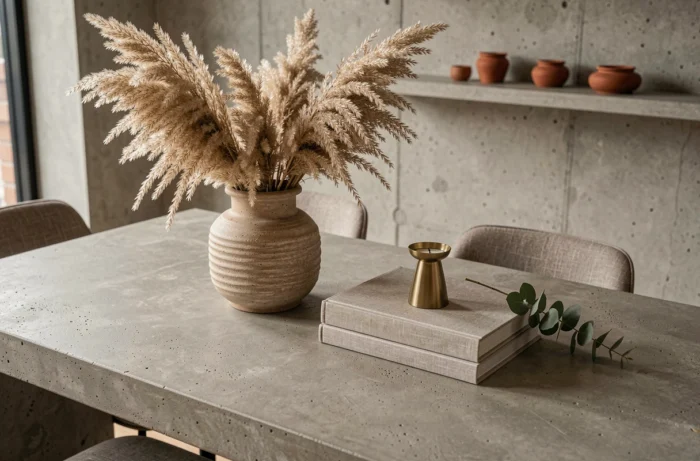
We observe that furniture designed to be disassembled, reupholstered, or whose wear parts can be replaced is becoming more relevant. A solid wood frame sofa with a reupholstered seat costs more at purchase, but its lifecycle far exceeds that of a stapled frame model. The style is not compromised: clean lines, tapered legs, and textured fabrics remain compatible with a construction designed to last.
Before investing in a piece of designer furniture, check three points:
- Is the structure disassemblable without destruction (screws, dowels, mechanical joints rather than glue and staples)?
- Can the textile covering be removed and replaced by an upholsterer, or is it glued directly onto the foam?
- Does the manufacturer communicate about the origin of the wood and the composition of the foams (certification, accessible technical sheet)?
These checks take a few minutes and prevent the need to renew an entire living room every five years, which remains the least sustainable decorative gesture.
Upholstery textiles and chemical treatments: the case of PFAS
Stain-resistant and water-repellent treatments applied to upholstery fabrics often rely on PFAS (per- and polyfluoroalkyl substances). The French ban should extend to upholstery textiles, which will redistribute the cards for cushion covers, curtains, and sofa coverings.
In practice, this means that chemically treated “easy clean” fabrics will gradually disappear in favor of naturally resistant fibers. Thick linen, tightly woven cottons, or looped wools provide decent stain resistance without surface treatment. Their raw texture fits perfectly into current trends that favor visible and tactile materials over smooth and uniform surfaces.
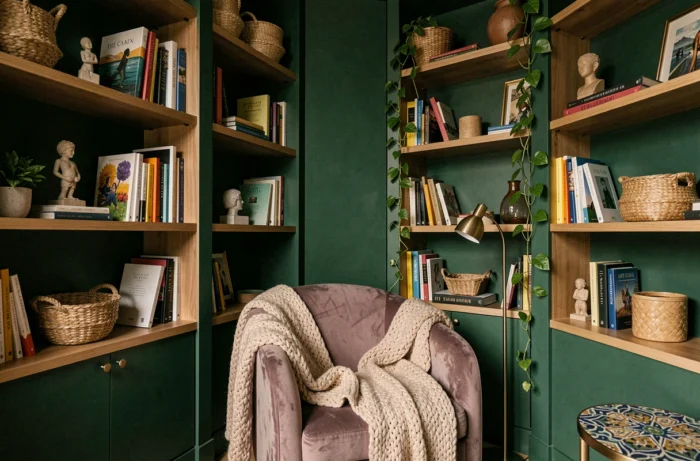
For high-traffic areas (living room, dining room), we recommend opting for removable, machine-washable covers rather than relying on a chemical treatment. This technical choice also becomes a decorative choice: changing the cover according to the season allows you to refresh the ambiance of a space without replacing the furniture.
Colors and materials: balancing trend and longevity
The palettes dominating interiors this season revolve around muted blues, deep greens, and terracotta shades. We find that these colors work better on matte surfaces (plasters, mineral paints) than on satin finishes, as matte absorbs light and enhances the perception of depth.
A common mistake is to apply a strong color to all four walls of a room. One accent wall is enough to anchor the visual identity of the space. The other walls should remain in warm neutral tones (off-white, stone beige, light gray) that serve as a backdrop for furniture and objects.
In terms of materials, dark wood (walnut, smoked oak) adds structure to the decor without weighing it down if used on one or two key pieces: dining table, entry console, wall shelf. Amber glass, in lighting or decorative objects, filters light and creates an atmosphere that transparent glass competitors do not produce.
- A looped wool rug in a muted shade visually anchors the living room and absorbs footstep noise.
- Washed linen cushions, untreated, in a maximum of two colors avoid visual overload.
- An amber glass lamp placed low (table lamp, low pendant above a table) warms the space better than white ceiling lighting.
The most sustainable trendy decor remains that which combines healthy materials, reparable furniture, and measured color choices. Trends come and go, but a well-applied plaster and a well-built sofa endure.